



What an incredible time to be an entrepreneur.
AI is bursting at the seams with a velocity I haven’t seen since the first dot-com era. I was a teenager then, but the energy today feels familiar.
It’s hard not to get swept up in the optimism of what can be.
But optimism is the easy part.
The harder truth is this:
People will have to adjust.
And most people do not adjust well.
1995
In 1995, I got my first real job installing computers.
I walked into the office of an older man who looked up from his desk and said:
“Kid, I’ve got pencil and paper.”
A month later, he didn’t have a job.
The landscape was shifting. Desktop computers were moving into every office. Email addresses were replacing fax machines and copy rooms. Competence built in one era was becoming irrelevant in the next.
At the time, I couldn’t understand it.
Why resist something that could make you more effective?
Years later, I realized it wasn’t about intelligence.
It was about disposition.
You have to enjoy change.
Or at least respect it.
You have to believe you can ride the wave instead of being pulled under it.
And the hardest part?
That decision is entirely yours.

The Foundation
Most of my thinking returns to the same base:
Accountability. Intellectual honesty. Grit.
These are the building blocks.
This AI phase is no different.
Machines can now generate, analyze, design, simulate, and accelerate at a scale that would have been unthinkable even five years ago.
They compress time.
They compress cost.
They compress iteration.
What they do not eliminate is human fragility.
Adjustment is possible, even painful adjustment, if you’re willing to engage in a brutally honest internal debate that boils down to one question:
What choice do you really have?
The tools are not slowing down.
If anything, they are pushing more domains toward zero, marginal cost, friction, barriers to entry.
That doesn’t eliminate opportunity.
It reshapes it.
The window to learn is open.
It will not remain open forever.
Three Rules
Know who you are
Know what you want
Know how to communicate
These rules apply to leadership, parenting, management, and now AI.

In essence, we have access to a savant apprentice. One that can absorb context, process information at speed, and produce work continuously.
Over time, if guided properly, it becomes indispensable.
But only if you treat it properly.
It’s not a chatbot.
It’s not a party trick.
It is leverage without judgment.
And leverage amplifies whatever you bring to it.
If you communicate lazily, you get mediocrity.
If you communicate clearly, you get acceleration.
Garbage in, garbage out.
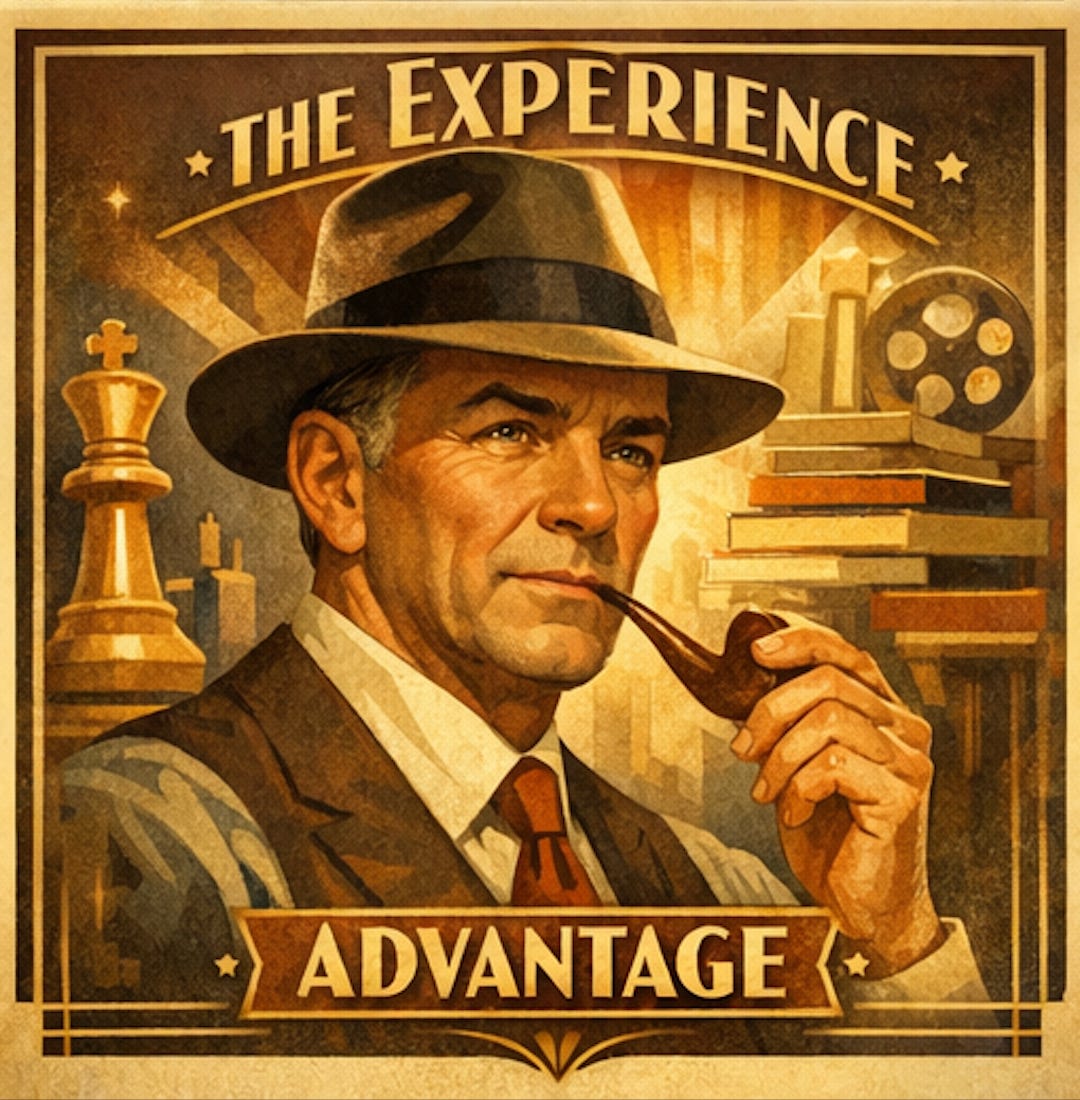
The Experience Advantage
Anyone over 40 has a potential advantage.
Experience, if you were paying attention, is now an asset that can be embedded into these systems. Your judgment. Your taste. Your scars. Your pattern recognition.
Youth has speed.
Experience has direction.
When layered onto AI, direction becomes force.
But experience alone isn’t enough.
It has to be integrated.
When I watch people use AI for the first time, I’m often struck by their level of curiosity, or the absence of it.
And I think back to 1995.
Communication was already hard between people. Now it’s revealing when directed at a system that will respond to almost anything you feed it.
Some models flatter you. Some are indifferent. The result depends on how you engage.
If you know who you are and communicate with clarity, you create a recursive environment where quality compounds.
Think about your best interns or young hires. If you invested in them, you saw the transformation.
The environment determines the growth.
AI behaves similarly.
Only faster.
Quantum Leap
Twenty-five years ago, a few young men started a video game company. They survived recessions, platform shifts, market bubbles, and product failures.
Today, they sit on decades of experience and data.
Layer AI on top of that foundation, and the curve bends.
Everyone has a version of this story. A body of experience. A hidden archive of lessons.
The mission now is unlocking it.
At a recent conference, I caught myself saying:
“If only we had these tools when we were 20.”
Then I corrected myself.
Even if we had the tools, we wouldn’t have had the judgment to use them properly. We would have failed faster.
Which, to be fair, is still progress.
But it would have required curiosity.
It would have required a learning mindset.
And those are traits no one can give you.
The technology isn’t the separator.
Disposition is.
The wave is here.
The question is simple:
Will you ride it, or insist on pencil and paper?
All images generated by GPT & prompted by the Author.